Guide: artificial evolution with DarwinBot
Versão em português: guia-evolucao.md
This guide is for anyone who has never touched evolutionary algorithms and wants to understand how DarwinBot invents robots. Each section explains one idea in a few words and points to where it lives in the code, so you can read it, run it and change it.
You don't need any math beyond high school. You need curiosity and an ordinary computer: everything here runs on a laptop.
1. The idea in one minute
Natural evolution needs three ingredients:
- variation: children are not perfect copies of their parents;
- selection: not everyone survives, and the ones that work better leave more descendants;
- inheritance: what worked is passed on to the next generation.
Repeat that many times and solutions appear that nobody designed. An evolutionary algorithm does exactly this inside the computer: it creates candidates, measures how good they are, keeps the best ones and generates variations of them.
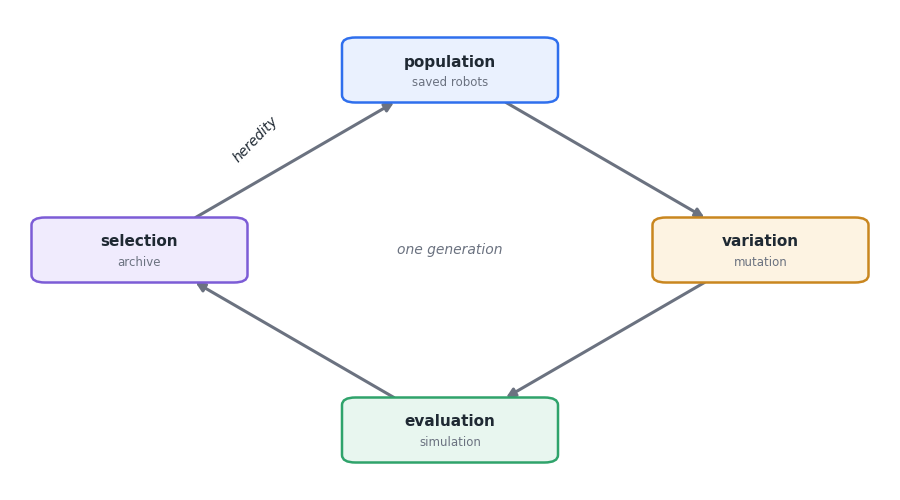
The technique is used outside robotics too: NASA evolved the shape of an antenna that flew on the ST5 satellite (2006), and there are uses in part design, task scheduling and tuning neural networks. It shines when the problem is hard to solve with formulas but easy to evaluate ("how many meters did this robot walk?").
2. Genotype and phenotype
In biology, the genotype is the DNA and the phenotype is the organism it produces. In DarwinBot:
- the genotype is a vector of numbers between 0 and 1;
- the phenotype is the robot's body: a tree of modules (trunk, spine segments, servo joints, links, TPU springs, wheels, feet, tails, skids, spikes and free caster wheels).
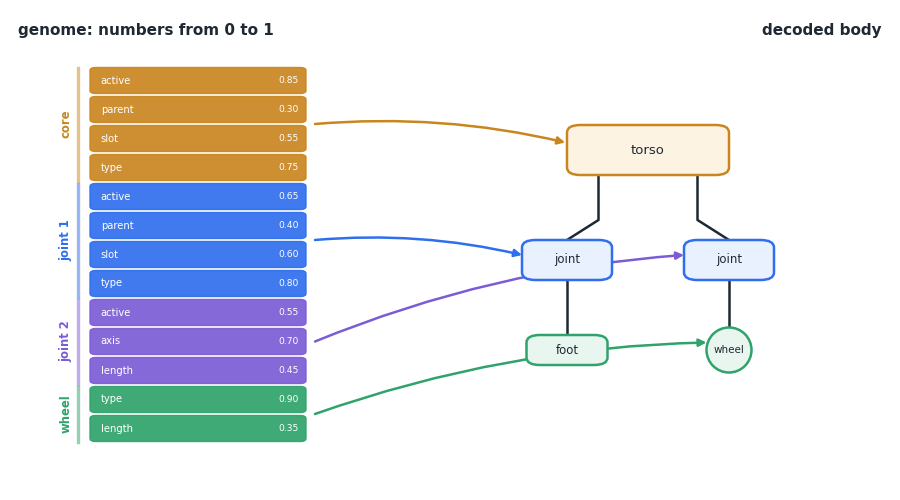
The vector is split into blocks, one per module "slot". Each block says whether the slot is active, who the parent is, which socket it attaches to, what type of module it is, the joint axis, the link length and so on.
The measures are continuous: link length goes from 40 to 200 mm, the section from 12 to 30 mm by 3 to 10 mm, the elbow has its own distance and angle, the mount rolls to any angle and can sit anywhere along the torso edge, top or bottom. The trunk outline is an 8-vertex polygon that evolution reshapes, a link can be straight, L-shaped or arc-shaped, a foot can be a sphere, blade, pad or claw, and the trunk can grow up to two extra plates joined by spine servos. Each block has 15 genes. The passive modules (spring, tail with counterweight, skid, spike, caster) have no servo.
In the code: darwinbot/morphology.py, functions decode (genome to
body) and encode (body to genome).
One important detail: decode accepts any vector and always returns a
valid body. Slots that contradict each other are discarded. This looks
small, but it is what lets mutation tinker freely without producing
impossible "monsters".
3. Mutation
Variation comes from mutation: take a robot that works and change it a little. DarwinBot uses seven operators, drawn with different weights. Each child gets one to three of them in a row:
| Operator | What it does | Chance |
|---|---|---|
param |
changes a continuous measure (length, section, elbow, roll, radius, trunk outline, link bend, foot shape); one change in five is a large jump | 30% |
add |
adds a module in a free socket | 20% |
type |
swaps a module's type (a joint becomes a link, spring, tail, skid, spike or caster, for example) | 15% |
mirror |
copies a limb to the opposite side, mirrored | 15% |
remove |
removes a whole limb | 10% |
copy |
copies a limb to another socket | 5% |
scale |
stretches or shrinks a whole limb, from half to double | 5% |
The mirror operator deserves attention: symmetry helps walking, and
duplicating a limb that already works is a shortcut that natural evolution
also uses (think of an insect's pairs of legs).
In the code: MUTATIONS and the _op_* functions in morphology.py.
Many genetic algorithms also use crossover (mixing the genome of two parents). Cutting two bodies in half and swapping the halves almost always breaks both, so DarwinBot uses a gentler form, the graft: a whole limb of another robot on the map is attached to a free slot of the parent, sometimes mirrored on the other side. One child in five is born this way. Karl Sims used the same idea for his creatures in 1994.
Besides the children, one body in ten in every batch is drawn from scratch, with no parent. It brings variety from outside, like a migrant reaching an isolated population: now and then a new body finds a way to move that no family on the map had.
4. The score (fitness)
Selection needs a criterion. A robot's score, after a few seconds of simulation, is:
score = forward progress - 0.5 × lateral drift - 0.2 × heading change - 0.05 × energy spent - 0.5 × (fell?)
Walking forward earns points; walking crooked, curving when not asked to, spending too much energy and falling lose points. With several terrains, the final score mixes the average with the worst terrain, to reward robust robots.
In the code: darwinbot/fitness.py.
Be careful what you ask for. Evolution optimizes the score, not your intention. If the score has a loophole, it will be found: there are famous cases of simulated robots that learned to "walk" by exploiting physics bugs, or to earn points by falling in a specific way. DarwinBot already guards against some of them: a body with overlapping parts isn't even simulated, and physics that "explodes" gets a score of -5. A good exercise is to change the score and see what cheating shows up.
5. Two loops: body and brain
A new body doesn't know how to walk. If we judged the body with a random movement, we would discard good bodies just because the drawn movement was bad. That is why DarwinBot has two loops, one inside the other:
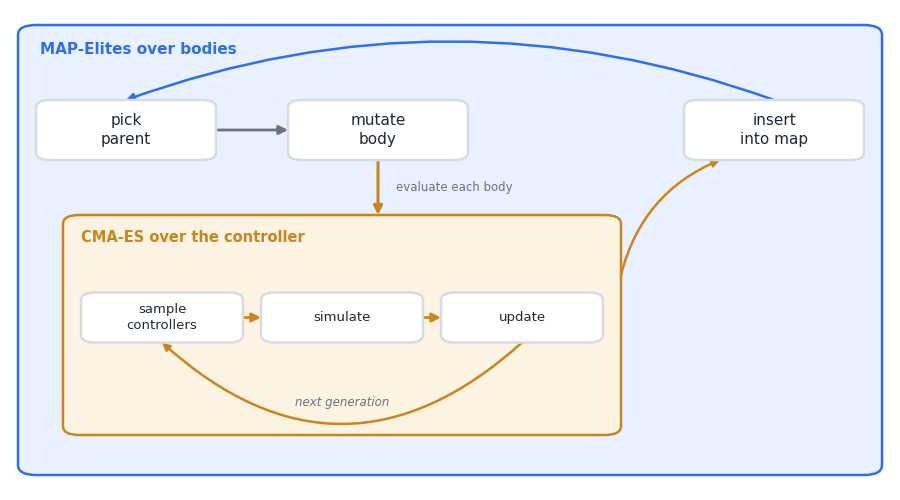
- Outer loop (bodies): picks parents, creates mutant bodies and keeps the best ones. That is MAP-Elites, in section 6.
- Inner loop (control): for each new body, CMA-ES searches for the joint movement rhythm that takes that body furthest.
The control is a CPG (central pattern generator): each joint follows a wave, with its own amplitude, phase and offset, like the spinal circuits that generate the walking rhythm in animals. A feedback from the servo load (Tegotae) lets each leg delay or advance its step according to the weight it carries.
CMA-ES without heavy math
CMA-ES is an evolution strategy, a cousin of genetic algorithms. It draws a cloud of candidates around a point, measures them all, moves the center toward the best ones and adjusts the shape of the cloud: it stretches in the direction that is working and shrinks when it gets close to the optimum.
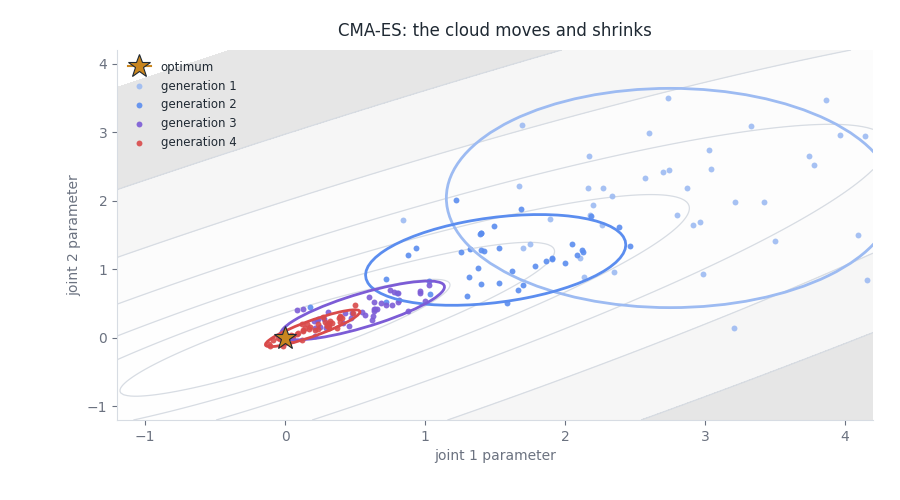
In the code: darwinbot/inner.py (uses the pycma library) and
darwinbot/controller.py (the CPG).
6. Quality diversity: the best of each kind
A classic genetic algorithm looks for one winner. The problem is that the population tends to converge: everyone becomes a copy of the first robot that worked reasonably well, and different ideas die before they mature.
MAP-Elites (Mouret and Clune, 2015) does it differently. It divides the behavior space into a map and keeps the best robot of each region. In DarwinBot, the axes of the map are:
duty: how long the feet stay on the ground (crawling, walking, trotting);height: trunk height;legs: number of legs (limbs with a joint and no wheel);cot: cost of transport (energy per weight and distance).
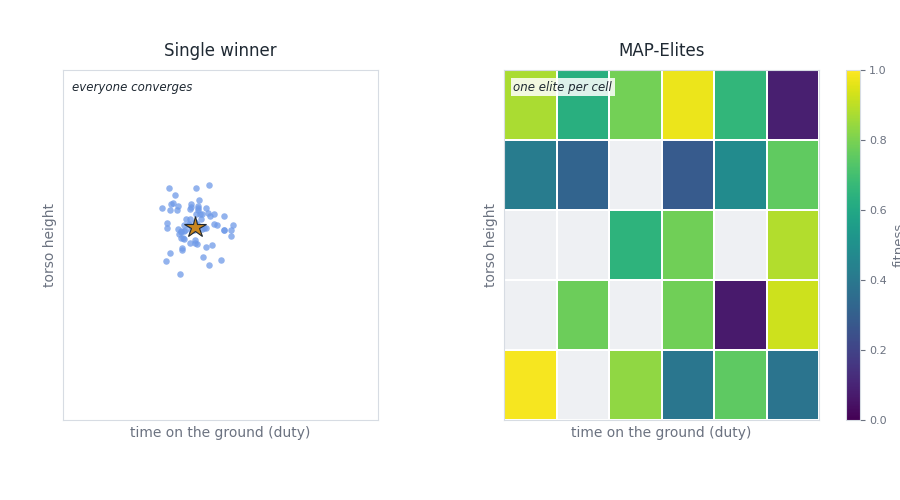
A new robot only competes with the current owner of its region. So a slow crawler stays on the map next to a fast roller, and the result is a catalog of different solutions.
There is a less obvious gain: the regions serve as stepping stones. A champion robot often descends from ancestors that lived in very different regions. A search for a single winner would have thrown those ancestors away.
In the code: darwinbot/evolve.py (Archive class, uses the pyribs
library). To see the stepping stones: python experiments/lineage.py.
7. Novelty and inheritance
Who becomes a parent. Instead of drawing parents at random, DarwinBot
gives more chance to robots that are isolated on the map, far from their
neighbors (--parent-selection novelty). This pushes the search toward
little-explored regions. It is a version of the "novelty search" of Lehman
and Stanley.
What the child inherits. The child inherits the mutated body and also the control the parent learned, and starts CMA-ES from there. This is Lamarckian inheritance (inheriting what the parent learned in life): wrong in biology, but great in the computer, because the child doesn't relearn how to walk from scratch.
8. From simulator to the real world
Robots evolved in simulation usually fail in the real world (the "reality gap"): evolution explores details of the simulated physics that don't really exist. DarwinBot uses three defenses:
- Real parts: only STS3215 servos, printed parts and electronics you can buy, with mass and torque from the catalog.
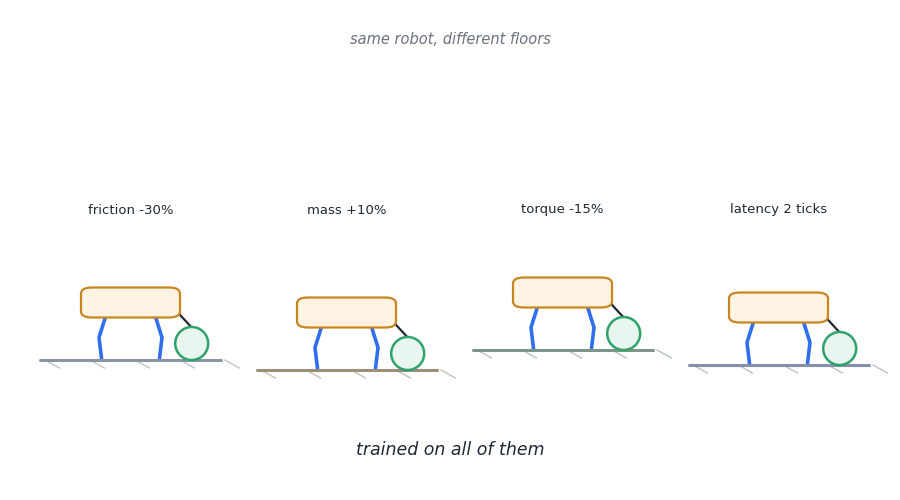
- Varied physics (domain randomization): each robot is trained in versions with slightly different friction, mass, torque, backlash and delay. A movement that only works under one exact physics doesn't survive.
- Validation:
experiments/validate.pytests the robot under 50 varied physics and approves it if it loses less than 30% of its performance.
There is a fourth defense, natural selection by the printer: a body is buildable only if every part fits a 220 mm print bed, every link survives the servo stall torque (2.94 N*m) with a bending stress of at most 25 MPa (half of what PLA takes), and no parts overlap. The torso has no limit: it is split into bed-sized tiles joined by splice plates, and each spine segment is its own plate. A body that breaks a rule is scored as unbuildable and is never simulated.
In the code: darwinbot/randomize.py.
9. Try it
The commands run from the project root, with the environment installed (see the README). Small trainings take minutes.
- A minimal training to see the cycle:
Watch the
python experiments/train.py --terrains flat --init 6 --batches 3 --batch-size 4 --budget-init 20 --budget-child 10 --workers 1 --variants 0 --seed 1 --out /tmp/exp1 python experiments/replay.py --archive /tmp/exp1/archive.pkl --listcellscolumn of thetrain.pylog grow with each batch: those are the new kinds found (replay.py --listprints the types themselves). - Novelty versus random draw: repeat with
--parent-selection uniformand the same--seed. How many kinds did each one find? - Change the score: in
darwinbot/fitness.py, setENERGY_Wto zero (free energy). Do the robots get faster? More clumsy? - See a robot:
python experiments/replay.py --archive /tmp/exp1/archive.pkl --type <type>opens the 3D viewer. - Follow a lineage: train more batches and run
python experiments/lineage.py --archive /tmp/exp1/archive.pkl --type <type>.
10. Glossary
| Term | Meaning |
|---|---|
| Genotype / genome | the numbers that describe a robot |
| Phenotype | the robot built from the genome |
| Fitness / score | how well the robot performs the task |
| Mutation | a random change in a child's genome |
| Crossover | mixing the genome of two parents (here, grafting a whole limb) |
| Elite | the best robot kept in a region of the map |
| Descriptor | a behavior measurement that defines a robot's region |
| CPG | central pattern generator, the rhythmic control of the joints |
| CMA-ES | evolution strategy that tunes the control |
| MAP-Elites | algorithm that keeps the best of each region |
| Reality gap | the difference between simulation and the real world |
11. Further reading
- K. Sims, "Evolving Virtual Creatures", SIGGRAPH 1994. The classic: creatures with evolved body and brain, the origin of the tree body.
- J.-B. Mouret and J. Clune, "Illuminating search spaces by mapping elites",
- MAP-Elites.
- J. Lehman and K. O. Stanley, "Abandoning Objectives: Evolution Through the Search for Novelty Alone", 2011. Novelty search.
- N. Hansen, "The CMA Evolution Strategy: A Tutorial", 2016.
- J. Lehman et al., "The Surprising Creativity of Digital Evolution", 2018. A collection of "cheats" found by evolution, a great read.
- A. E. Eiben and J. E. Smith, Introduction to Evolutionary Computing, Springer. The textbook of the field.